Concepts and wording
Datamodel
The following overview summarizes the underlying data processing model of this framework:
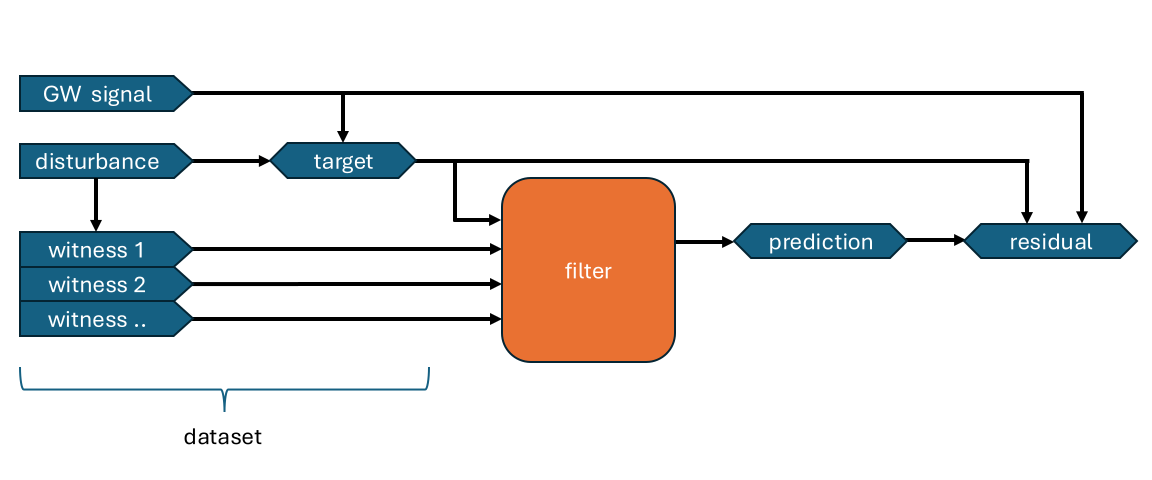
Noise cancellation methods are called filters to have a shorter name
The goal of the filters is to make an as good as possible prediction of the disturbance channel based on the target and witness signals.
For that, the ideal filter is calculated from a conditioning dataset (comparable to a training dataset in machine learning) and then applied to a evaluation dataset (comparable to a test dataset) to analyze its performance. The conditioning and evaluation datasets are independent of each other, i.e. they contain different realizations of the signals.
A dataset defines a set of signals that can be used to test filtering techniques
Each dataset contains one target channel, one or multiple witness channels and optionally one GW signals channel
The GW signal or short signal channel contains the useful signal that should be recovered through cancellation
In a real-world application, only the witness and target channels would be available. The exact realization of the GW signal and disturbance channels would be unknown
To evaluate the performance on simulated data, the GW signal channel can be added. The disturbance channel is implicitly defined as the difference between target and GW signal
The residual signal is the most relevant indicator of the cancellation performance. It indicates the difference between the prediction and the targeted disturbance
Concepts
Hashing is used to prevent unnecessary rerunning of calculations
All objects that are part of an evaluation run configuration run provide a comparable hash that is a unique, comparable indicator of their configuration and version
These hashes are e.g. used in filenames to determine if a result for a given calcuation is already available
The python __hash__ interface is randomized for every session of the python interpreter for security reasons. It is therefore not usable here.